Saying Goodbye to Eleanor Johnson
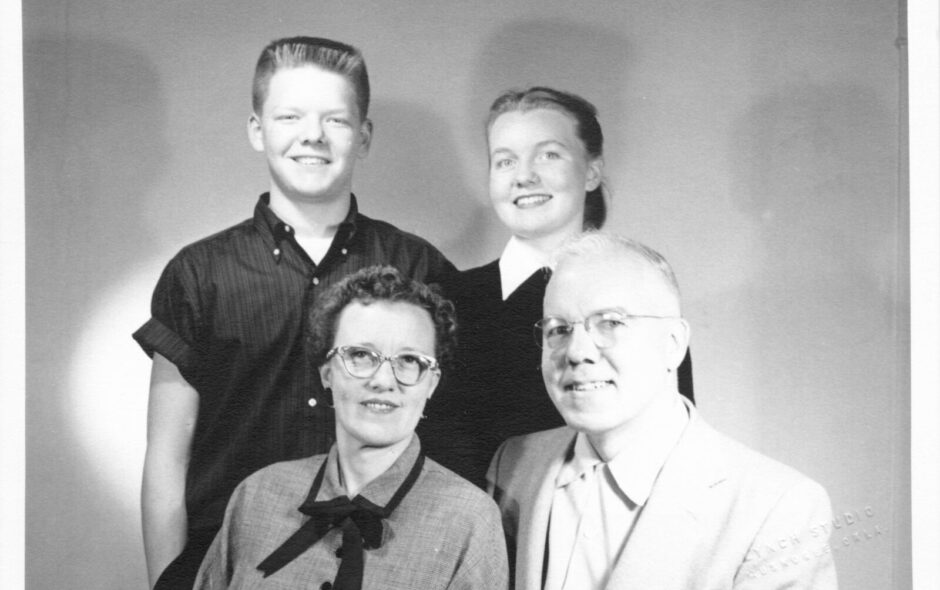
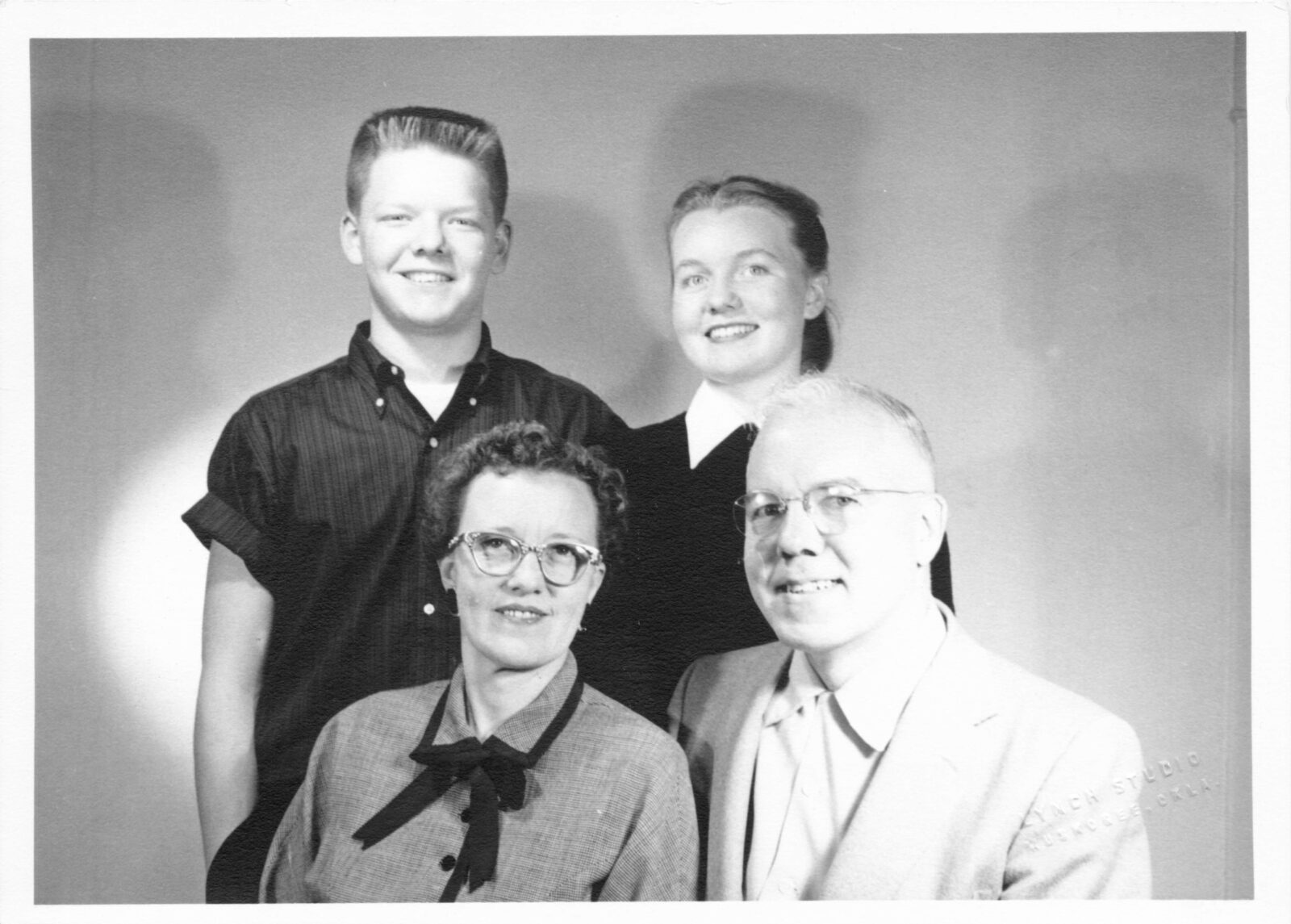
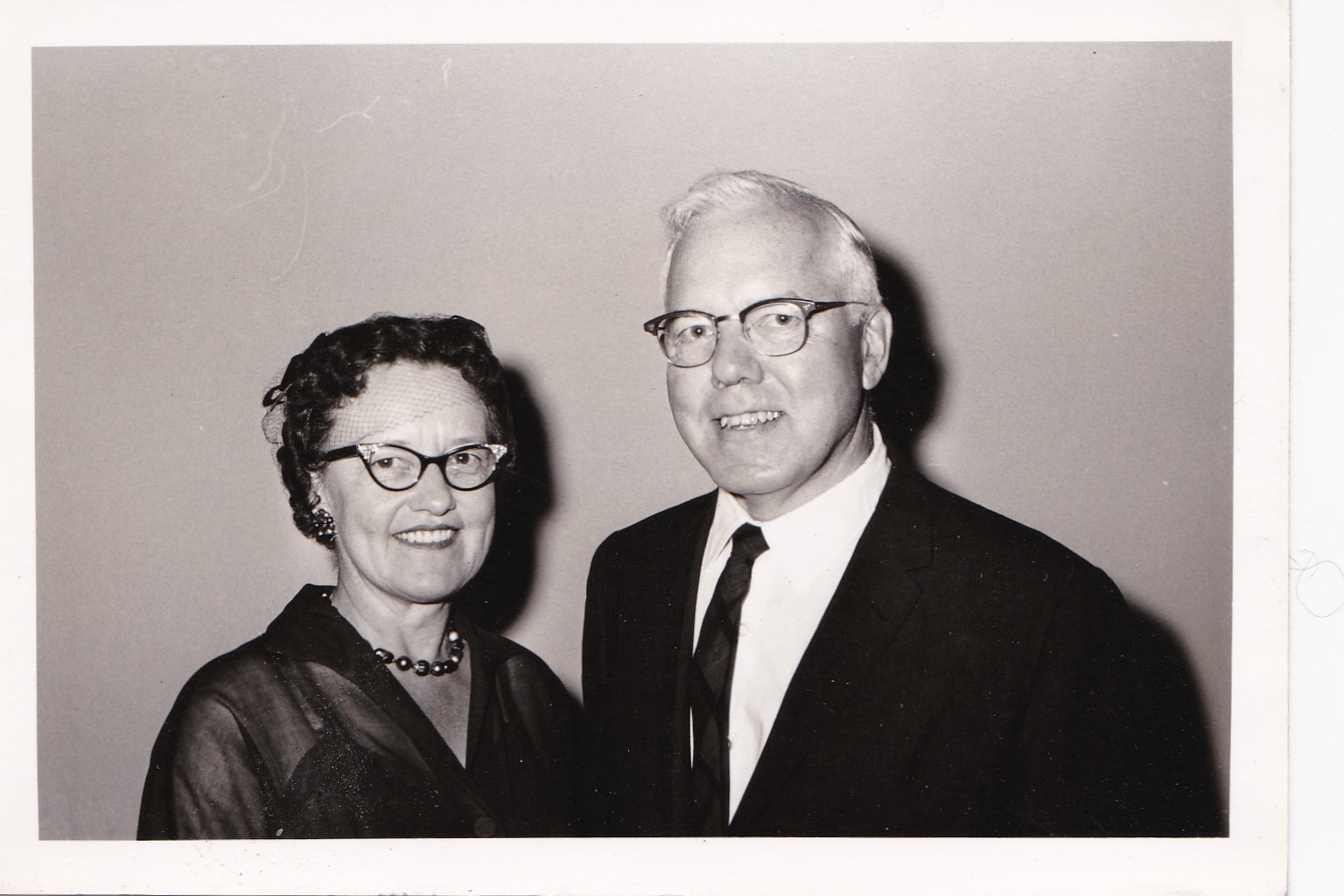
My brothers and I had been alternating weekends, flying into Tulsa where Mom is in the hospital so our father could go home to Muskogee and sleep in his own bed. We had hoped to bring our spouses and children to celebrate our parents’ fiftieth wedding anniversary at the Muskogee Country Club, but the celebration took place in the Muskogee General Hospital instead. Mom put a brave face on it, hugging each grandchild who bent over her frail body in the wheelchair, oxygen flowing through a tube that distorted her playful smile.
On what turned out to be my last visit to see her, I perched on the commode by the bed in their master bedroom. It was late June 1986. Mom couldn’t make it to the bathroom anymore. Her face was contorted in pain. I put my hand on her thin leg which barely raised a hump under the summer blanket. She looked at me and tried to smile.
“Mom,” I started to speak about my disappointments in how far we had drifted apart, how distant we had become. How I never told her anything anymore. Our phone conversations had been strained and stilted. Her smile twisted into a grimace.
I began again, “Mom,” I said. My father appeared beside me demanding that I say nothing. “Nothing sad. Don’t make her cry. We’ll have no tears. You’ll get her crying. None of that.” I never got any words out. Instead, I looked up at him and said, “she needs more morphine. She is in terrible pain. Let her have morphine.” “It hasn’t been four hours yet. She has to wait.” “Why?” I said defiantly, getting up from her side to face him, chin raised.
He grabbed me by the shoulders, pulling me to the foot of the bed, face into mine. “I am her doctor. How dare you question me? I will decide. How can you bring this up in front of her? She trusts me.”
I turned to look at Mom, whose head drooped sideways on her propped-up pillow. She whimpered to the room, to the universe, “I’ll never please him.”
When I flew home to Seattle the next day, I didn’t realize it was the last time I would see her alive. She died on the fourth of July. I called Grace, her oldest granddaughter, to tell her grandma had died that morning. “Independence Day for Grandma,” was her solemn response. She was gone without my words of comfort, my thanks for her mothering, my goodbye “I love you.”
Against my father’s wishes, I flew back for the memorial service. “Don’t come!” He had admonished. “I don’t want you here.” “I am coming. I need this memorial service,” I had said, buying the plane ticket.
Aunt Ethel, Mom’s sister and best friend had been in Muskogee through the last days. Together she and I went through Mom’s drawers and closets loading bag after bag for Goodwill. There were five left breast prostheses, weighty, pendulous like the breasts I knew as a child. I was stunned. I had worn a prosthesis for years and years and never had more than one at a time. My breast cancer was long before hers.
We went through the furs: a luxurious cape of sable, a full length black bear, too heavy to wear in Oklahoma, anywhere—it weighed a ton; the foxes with their glass eyes, two head to toe across the shoulders and one more on each side, teeth grasping their compadres at the base of the tail, their own tails hanging down; the fur car-coat reaching just below the wearer’s bottom.
We worked without comment.
I held inside a screaming stream of judgment, the condemnation of waste, of animal cruelty, of critical assumptions about her insecurities needing to own all this stuff. Aunt Ethel worked beside me saying nothing. She had scrimped all her life, leaving with Uncle Marty each morning to take the subway from the Bronx to lower Manhattan. She worked as a secretary; he as a meat packer on the Lower East Side. He had dropped dead in my parents’ kitchen on their very first vacation after he retired some years earlier. Aunt Ethel’s hand touched her pocketed rosary, a little blessing between each filled black garbage bag.
The service began. Her friends huddled on the left filling several rows of the large St. Paul’s Methodist sanctuary. The center section was reserved for family. My brother Eric, my father, my aunt and I sat in the front row, missing Lyman. He did not come, obedient to our father’s wish that none of us children show up. No spouses. No grandchildren. The rest of that vast space was empty.
The minister did not capture my mother. He had not known her. His eulogy was off the mark, something about the salt of the earth.
“No!” I screamed inside, not the salt of the earth. More like the lilies of the field, the swallows that soared. She was a dancer, a singer, an artisan who painted, did needle point, knitted, sewed beautiful complex clothes for herself, for me, for her granddaughters. She led the square dances. She took my arm and skipped down the sidewalk. She played the violin. She was a fireball with snappy, brown-eyed anger and joy and a mind for detail that made the Hospital Auxiliary’s store a profit center. I should have told her life. I was neither asked to do so nor would I have been permitted.
My father, my molester, wanted it impersonal, the more impersonal the better. In the church parlor the ladies had coffee, tea, cakes laid out with the best Methodist linen, doilies and silver, lemon slices like paten on a silver tray, a two-pronged fork nearby. My father stood severe and unapproachable and left the church as soon as he decently could. He made sure everyone present knew that they would not be welcome at our home that afternoon or anytime later.
At home, a truck delivered three trays of sandwiches, fruit, crackers and cheese, little cookies. I opened the door and let the man deliver them to the kitchen table. We had food for seventy people. The town was so scared of Dr. Port Johnson that no one came. Like some malevolent Greek god, he vaporized a small town’s formulaic funeral behavior. Nearly everyone forgot their lines. Mom, who hosted every event graciously, calmly, was neither present in body nor in spirit. I stumbled though my sudden tasks as mistress of this house with no compass. My brother, my aunt, my father, and I were left to retreat to the far corners of the big rambling knotty pine home Eric, and I had been raised in, unable to speak to each other. Our dark-skinned maid sat in her servant’s corner with nothing to do.
One friend from down the street rang the doorbell and came in. I had always thought of her as Old Money. Their pillared porch was antebellum, a pre-civil war southern mansion. She had gone to the Hockaday School for girls in Dallas, Texas. She knew what was right to do and paid my father no heed. I was grateful for her visit. Her presence normalized the strange non-event Mom’s memorial turned out to be.
My father left Mom’s ashes at the morgue. Neglected again, she slipped into the category “Jane Doe.” Powerless against his wall of denial, I was left with no remains to cradle, no wooded glen or church yard, no headstone to visit. He annihilated what he could no longer depend on, salting the wound of my sorrow in the process. For weeks after her death, for years, I wandered the cemeteries in Seattle, in towns I passed through, locating my grief in their green lawns and head stones, finding the Johnson grave markers. Mom was a Johnson before she married, first-born child to Swedish-speaking Finns. When I read Johnson out loud, her body materialized, capable hands, spontaneous laughter, warmth filled the emptiness for a moment.
Less than a month after Mom’s death, my daughter Eleanor, her namesake, married on an island north of Seattle. My father came. He did not stop at our home but sped in his rental car to the home of a college classmate who had vacation property on the island. Mom had planned to dance at Eleanor’s wedding. During the ceremony Daddy was a stoic figure on a folding chair. After the cake was cut, the guests mingled enjoying the feast. A friend came up and took my elbow. “You’d better come to see about your father,” he said, leading me to a table where Daddy sat alone, sobbing into his handkerchief. “She should have been here. She should have been here. She … wanted … this … so much.”
I put my arms around him. Our embrace washed away all the shame. Our bodies touched as father and daughter. No sexual overtones. That moment fixed itself in my flesh as a blessing. We grieved together for our common loss. Mere seconds passed before he cleared his throat, stood straight and said, “she would have made this wedding what it could have been.”
With that final judgment, he vanished. I never saw him again. He put a gun to his head years later. My brothers and I showed up for his funeral. The minister extolled a man I never knew, some public persona no one ever challenged. At his command, his ashes were never laid to rest.
An earlier version of Saying Goodbye to Eleanor Johnson appeared in the Oklahoma Review.
My mother was seventy-six when she died; my father ninety when he took his own life. In my own family, the Bells and later with the Finneys, we all surrounded our dying husbands, fathers–Don and Chuck–with stories, prayer, poetry, and song as they each took their last breaths, buoyed for their journey by the love they knew.
Join my email list for the latest news about creating a less dangerous world.
By submitting this form, you are consenting to receive marketing emails from: . You can revoke your consent to receive emails at any time by using the SafeUnsubscribe® link, found at the bottom of every email. Emails are serviced by Constant Contact